
Mechanistic Models. Exposure Insight.

Anthroium predicts human exposure early in drug discovery through physics-based modeling and virtual human models.

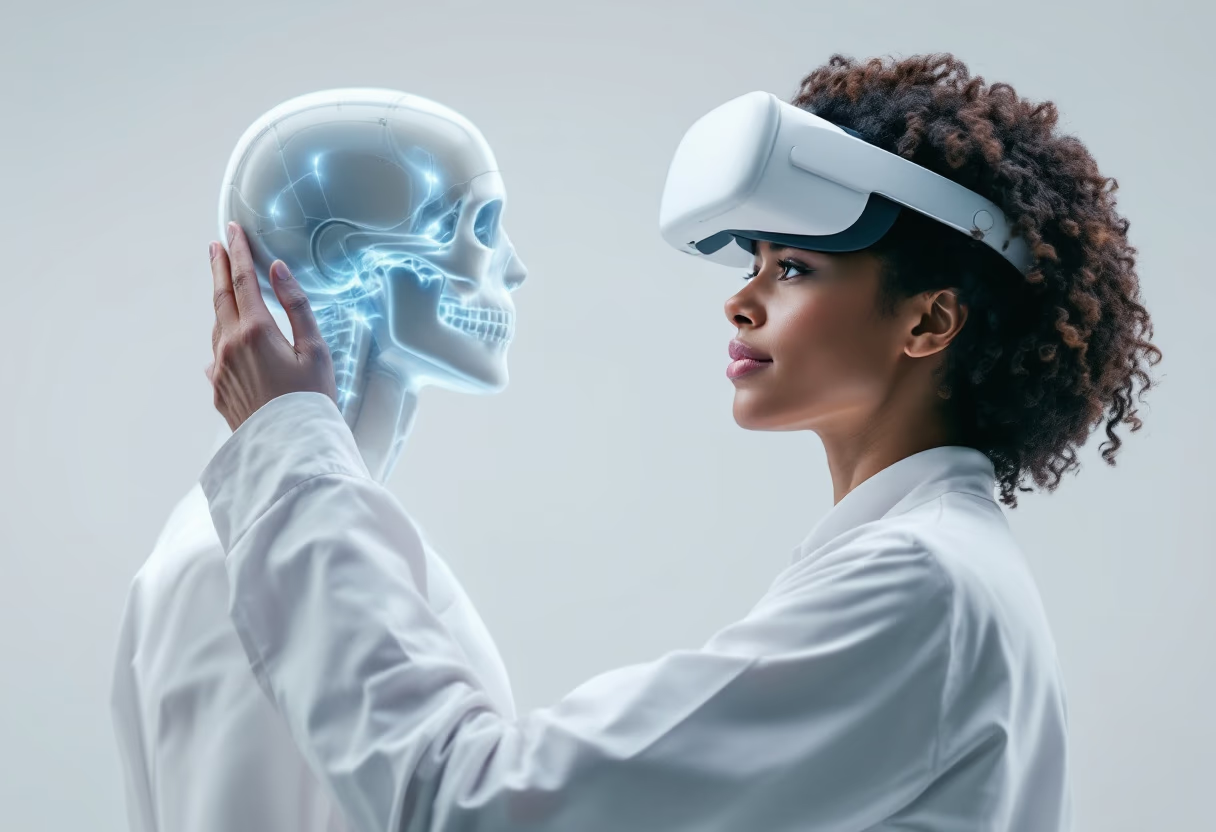
image of ar/vr experience in healthcare training
image of crop analysis process

What is Anthroium?

Key Focus Areas
Physiochemical Property Prediction
Mechanistic ADME Modelling
Human Exposure Prediction

Anthroium predicts how a drug behaves in the human body.
We connect molecular design to real-world exposure using mechanistic models—so teams can see risks earlier and make better decisions in the drug discovery process.

Human exposure cannot be inferred from molecular properties alone.

Why Molecular Design Isn’t Enough

Drug discovery tools can predict how a molecule behaves.
But they do not show how that molecule behaves inside a human body.


Human exposure depends on many interacting processes—absorption, transport, metabolism,
and distribution—not just molecular properties. This gap makes early exposure decisions difficult and uncertain.

Integrated Modeling Domains

[background image] image of abstract digital artwork (for a blockchain and cryptocurrency)

Computational Chemistry

Molecular-level structure and behavior as the foundation for downstream exposure reasoning.

image of dna helix with ai overlay

Mechanistic ADME

Biological processes governing absorption, distribution, metabolism, and excretion modeled explicitly.

image of crop analysis process

Translational Pharmacokinetics

Integration of mechanistic inputs into human-scale exposure and PBPK-ready frameworks.

45%

of failures are linked to exposure-driven efficacy or safety issues

90%

of molecules entering
clinical trials ultimately fail

$100M+

often invested before
exposure-related failure is identified

The Exposure Gap in Drug Discovery

Human exposure is one of the most common causes of drug failure.
And it remains hard to predict early in discovery.

Blue outlined illustration of four jigsaw puzzle pieces with one piece slightly separated.

Fragmented
ADME Insight

ADME tests are often run separately. Each result is useful on its own, but they are not connected. Without integration, exposure risk is judged piece by piece instead of as one biological system.

Icon of a computer monitor displaying a chemistry flask connected to a flowchart or list, representing scientific research.

Empirical Models Without Mechanistic Context

Many exposure predictions rely on historical correlations. They work within known chemical space—but often break when structure or biology changes. Without mechanistic grounding, it is hard to know why exposure is limited or how to fix it.

Blue radioactive hazard symbol with three triangular segments inside a circle.

Late Exposure
Visibility

Clear exposure insight often comes only after animal studies or late modeling. By then, chemistry strategy and program direction are already set. Late exposure surprises are expensive.

Blue molecular structure with interconnected circular nodes on a white background.

Exposure Is
Emergent

Human exposure is not driven by one property. It emerges from interacting processes—transport, metabolism, distribution, and physiology. Without modeling these interactions directly, early exposure reasoning remains uncertain.

OUR SOLUTION

Mechanistic ADME for Human Exposure

Anthroium models the biological processes that determine human exposure.

Instead of relying on correlations or isolated property screens, we integrate mechanistic ADME within a virtual human framework.

Why Human Exposure Is Hard to Predict

Human exposure is not controlled by one property. It results from many biological processes working together across the body from molecular, cellular and organs.

This complexity explains why exposure limits are often discovered late—
and why mechanistic modeling is needed earlier in discovery.

WORKFLOW

From Molecular Input to Exposure Insight

Anthroium introduces mechanistic exposure reasoning early in discovery.


We integrate with molecular modeling, in vitro assays, and early PK studies—helping teams identify exposure limits before committing to in vivo programs.

image of biotech research process for ai biotech company

1) Molecular Input

2) Transport Processes

3) Metabolic Pathways

4) Tissue Distribution

5) Integrated Exposure Reasoning

6) Decision-Grade Outputs

Why Anthroium

A Different Approach to Exposure Modeling


Most discovery platforms optimize molecules or predict individual properties.
They are not designed to model human exposure as an integrated biological system.


Anthroium was built specifically for exposure reasoning. We model transport, metabolism,
tissue distribution, and physiology together—within one mechanistic framework.

Conventional Discovery Platforms

  • Focus on molecular design and property optimization
  • Rely heavily on empirical correlations and isolated predictors
  • Evaluate ADME components independently
  • Require manual or ad hoc integration to assess exposure risk
  • Often surface exposure limitations late in development

Anthroium

  • Designed explicitly for exposure-centered reasoning
  • Models ADME as interacting biological mechanisms
  • Integrates molecular behavior into a virtual human framework
  • Produces PBPK-ready, interpretable outputs
  • Introduces mechanistic exposure insight earlier in discovery

Anthorium

Exposure-First Design

Anthroium is designed around human exposure as the primary outcome, rather than treating exposure as a downstream inference from isolated properties.

Mechanistic Integration

ADME processes are modeled as interacting biological mechanisms, enabling exposure reasoning that reflects how biology actually behaves across scales.

Virtual Human Framework

Mechanistic components are composed within a virtual human representation, providing physiological context for how molecular behavior translates into exposure.

Interpretability by Design

Models are constructed to preserve mechanistic transparency, supporting scientific understanding of why exposure is limited—not just whether it is.

PBPK-Ready Outputs

Outputs are structured to integrate directly with physiologically based pharmacokinetic workflows, supporting downstream translational modeling and decision-making.

Complementary Platform

Anthroium is designed to augment existing molecular modeling, experimental assays, and PK tools rather than replace them.

A New Modeling Layer for Human Exposure

Anthroium is a mechanistic modeling layer for human exposure. We connect molecular behavior to biological systems—so teams can reason about exposure earlier and with greater clarity.

  • Mechanistic by construction: Exposure is modeled as an emergent biological outcome, not inferred from isolated properties.

  • Decision-oriented: Designed to support earlier prioritization, redesign, and go/no-go decisions around exposure feasibility.

  • Built to integrate: Complements existing computational, experimental, and pharmacokinetic workflows rather than replacing them.

image of ar/vr experience in healthcare training

Platform Roadmap

From Molecular Mechanisms to Human Exposure

Anthroium follows a disciplined development path that prioritizes mechanistic fidelity, validation, and real-world applicability over rapid feature expansion.

Scientific Leadership

Scientific Team & Advisors

Anthroium is led by scientists and advisors with deep experience in mechanistic modeling, drug discovery, and translational decision-making. Platform development is guided by scientific rigor, interpretability, and real-world applicability.

[headshot] image of customer (for a real estate tech)
Ryan Dkystra
Founder & Chief Technology Officer
Ryan Dykstra leads Anthroium’s scientific vision and platform development. He holds a PhD in mechanistic modeling of molecular transformations, with a background in quantum chemistry and physics-based simulation. His work focuses on translating molecular-level mechanisms into interpretable, predictive ADME models that support earlier reasoning about human exposure.
[headshot] image of customer (for a construction company)
Michael Chen
Advisor, Capital & Strategic Partnerships
Michael Chen supports Anthroium through capital introduction and strategic fundraising efforts. He has experience working with early-stage biotech and deep-tech companies and leverages an MIT-affiliated network to help align scientific platforms with appropriate early-stage investment partners.
Careers

Join the Anthroium Team

We are looking for scientists and engineers who think across scales, from molecule to organ to human, and are motivated to reduce clinical trial failure through first-principles modeling.

We are currently engaging with early team members across scientific and technical roles. Early team members will help shape the scientific foundation of the platform and contribute directly to how mechanistic modeling is applied in drug discovery.

If you are interested, please email careers@anthroium.com with your CV or resume and a brief statement outlining your background and areas of expertise or interest.

[interface] image of employee interacting with hr software (for a hr tech)
Get Involved

Partner with Anthroium

Anthroium works with scientific and development teams interested in advancing exposure reasoning earlier in drug discovery. Current engagements focus on collaborative pilot programs, platform feedback, and strategic discussions aligned with mechanistic modeling and translational decision-making.

[background image] image of abstract digital artwork (for a blockchain and cryptocurrency)

Pilot Programs

Pilot engagements allow partners to apply Anthroium’s mechanistic ADME framework to real discovery challenges. These collaborations focus on exposure-limiting mechanisms, feasibility assessment, and early-stage decision support.

Best for: Discovery teams evaluating exposure risk early or exploring new modeling approaches.

event technology overview

Scientific Collaboration

Anthroium collaborates with academic and industry scientists interested in advancing mechanistic exposure modeling, validation strategies, and translational methodology.

Best for: Researchers and groups focused on ADME, pharmacokinetics, and systems-level modeling.

[background image] image of a futuristic laboratory setting (for a ai biotech company)

Strategic & Platform Discussions

Anthroium engages with strategic partners and investors aligned with long-term platform development, scientific rigor, and integration into real discovery workflows.

Best for: Organizations and individuals interested in supporting or shaping platform evolution.

Connect With Anthroium

We welcome inquiries from scientific teams, collaborators, and strategic partners interested in mechanistic exposure modeling. Please share a brief overview of your interest, and a member of the Anthroium team will follow up.

Thank you for reaching out!
Please try again.

Contact information

Connect with us for more details.

  • +1 (973) 617-6572
  • info@anthroium.com
  • New Jersey Bioscience Center Incubator at North Brunswick
    675 U.S. Highway 1
    North Brunswick, NJ 08902

Frequently asked questions

Clear answers on our modeling approach.

What does Anthroium’s MVP deliver?

The Anthroium MVP identifies dominant ADME mechanisms and computes exposure for primary small-molecule pathways, including passive diffusion and hepatic clearance. Later platform stages extend this framework to additional mechanisms and physiological complexity.

Is Anthroium a replacement for existing discovery tools?

No. Anthroium is designed to complement existing molecular modeling, experimental assays, and pharmacokinetic workflows by introducing mechanistic exposure reasoning earlier in discovery.

What stage of drug discovery is Anthroium designed for?

Anthroium is currently focused on early discovery and preclinical stages, where molecular design decisions remain flexible and exposure-related risks can still be addressed efficiently.

How is Anthroium different from PBPK modeling tools?

Traditional PBPK tools are typically applied later in development. Anthroium focuses on mechanistic ADME integration earlier in discovery, generating PBPK-ready outputs while preserving interpretability at the molecular level.

Is the platform available as software?

At present, Anthroium capabilities are delivered through pilot programs and services-assisted engagements, enabling close scientific collaboration as the platform continues to evolve.

Does Anthroium work across different therapeutic areas?

Anthroium is designed as a general mechanistic framework and can be applied across therapeutic areas where exposure plays a critical role in efficacy and safety.

How to apply to Anthroium?

If you’re interested in contributing and growing a career with Anthroium, please email careers@anthroium.com with your CV or resume along with a short note describing your background, what interests you about Anthroium, and what you would want to work on. Please use the subject line: “Anthroium – [Your Name] – Career Interest.”